
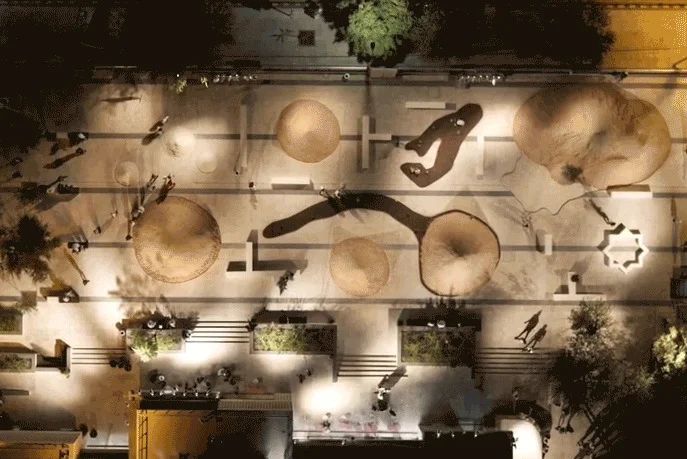
The Minor Paradise project essentially rebels against the traditional creation of gardens in the Mediterranean region. According to Islamic teachings, one of the primary representations of gardens in the arid regions of the Middle East is the depiction of paradise in earthly form. However, with the growing trend of drought in recent years and the need for flexible and resilient landscape projects, new approaches to landscaping and garden design have emerged.
This project was designed and executed in 2019 for the temporary exhibition space of “Amman Design Week” and can be categorized as an installation. According to the landscape architects involved, the project aimed to answer the following questions:
How can public spaces and collective outdoor life be envisioned in situations with limited water access?
How can the idea of a garden be reinterpreted during times of drought, especially in a cultural context where gardens are seen as earthly paradises due to abundant water and greenery?
The Minor Paradise project reinterprets landscape scenarios on a territorial scale by presenting miniature landscapes at a human scale, aiming to connect the project with the larger context of its surroundings. By creating hills, it introduces moments of concealment and revelation for the users. Given the temporary nature of the landscape, materials such as sand, gravel, volcanic rock, limestone, and native plants were “borrowed” from local contractors and nurseries for this installation.
The only built elements in the project were white benches made from plywood, symbolizing a typology of social spaces in the Arab world. These benches foster social interactions and, through their strategic placement, create various perspectives for visitors to observe the designed landscape. The small arches carved into the benches highlight the installation’s intentionally unscaled nature. Once the project was dismantled, these benches were relocated to a nearby green space and integrated into the urban environment.
Use of Dry Materials in Minor Paradise
The use of dry and native materials in Minor Paradise stands as one of the project’s greatest successes in creating a new approach to Mediterranean gardens. While the project can be considered a subset of xeriscaping, it notably lacks the presence of water and green elements typically associated with such designs. The concept of “temporality” was thoughtfully executed to align with the temporary nature of the exhibition itself.
However, there are certain aspects of the project that, from my perspective, warrant reconsideration and could strengthen the practice of designing new gardens in arid climates.
First, the absence of Iranian garden strategies, which were designed as paradises in desert landscapes, is evident. These gardens are products of drought, and their essence is intertwined with dryness. Perhaps the design approach seen in Minor Paradise could have benefited from drawing on the structural and conceptual principles of Persian gardens.
Moreover, the lack of shade structures and attention to cooling through shade or wind could have improved the overall user experience. This oversight suggests the landscape architects may have neglected to consider successful design strategies from similar climates.
Another point is the complete elimination of water elements from the design, which could be seen as a conceptual flaw. While the project addresses water scarcity, it seems to have sidestepped the issue entirely rather than addressing it creatively. The complete removal of the life-giving element in this climate is somewhat surprising and might lead viewers to question whether this landscaping approach is in opposition to xeriscaping practices (note: the term “dry landscaping” was intentionally avoided).
One of the major criticisms of this project is the lack of stabilization for the fine-grained materials used. It is evident that the landscape architect did not address one of the primary challenges of this climate: the high volumes of airborne dust. No solution was provided for this issue, and it represents a missed opportunity to turn this challenge into a unique feature of the project.
The central question the landscape architect seems to have avoided is: “How can a landscape be created in arid, low-water environments using local materials and plants, and how can this landscape be a solution to soil instability and dust in such regions?” The Middle East is in dire need of new, effective landscape design solutions to this challenge.
In conclusion, while Minor Paradise succeeds in terms of conceptual innovation, it falls short in addressing the practical needs of the climate. Nonetheless, it stands as a commendable exercise in rethinking garden and landscape design for hot, arid regions.
