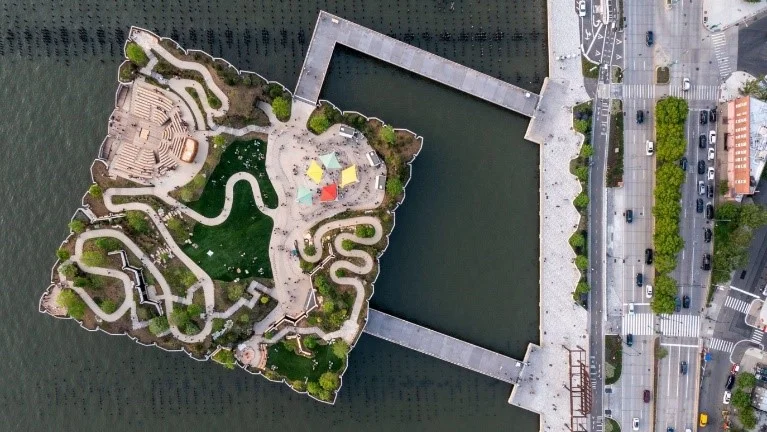
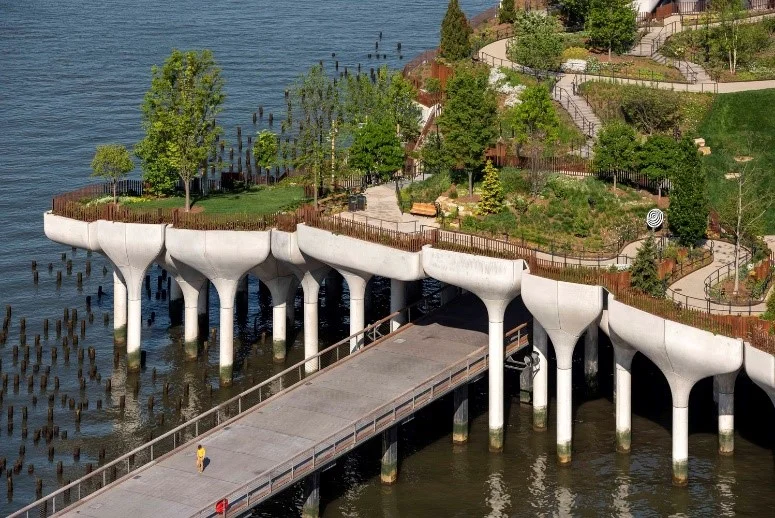
Thomas Heatherwick, the lead architect of this project, stated that his primary goal in its design was to create a space removed from the dominant urban structure of Manhattan. The main idea of the project is in harmony with the history of its location, with its supporting columns inspired by the remains of the old pier foundations at the site, now serving as habitats and breeding grounds for many aquatic species.
The structure of “Little Island” is fundamentally different from conventional piers. Traditionally, piers consisted of three parts: piles, pile caps, and a broad deck resting on them. However, Heatherwick innovated by combining these elements into a single unit, repeated 132 times with 39 different types of piles.
The surface of the project is undulating (featuring artificial topography), blending visually with its surroundings. Not only are the horizontal zones well organized, but they also vary in elevation across different areas. The writer believes one of the most appealing approaches to designing landscapes near water is creating spaces with varying elevations, as a viewer’s perception of water changes depending on their height relative to it. Heatherwick went further by offering users a higher vantage point above the site via a cable car.
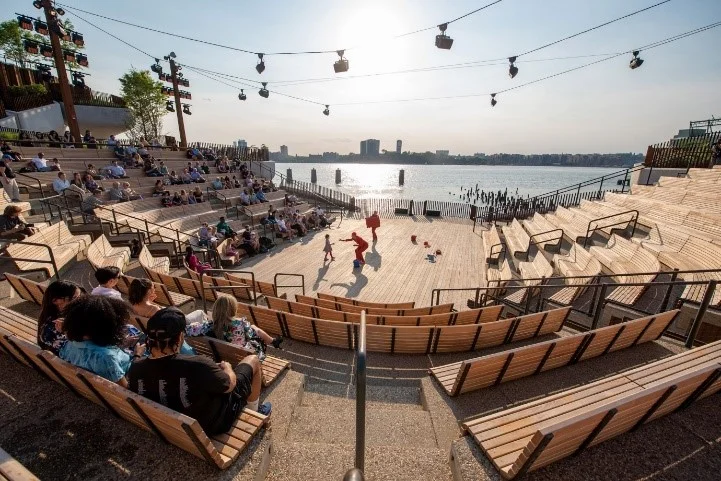
The project’s amphitheater features a water curtain as its backdrop, with water as the only visible element behind the stage. All mechanical systems were installed beneath the main deck to avoid visual clutter and other related issues.
This park offers over 540 meters of walking paths that flow smoothly with organic forms. The movement pathways and activity zones are well-integrated, providing services to visitors. In some places, the pathways lead users below the main deck of the park. However, considering Manhattan’s social dynamics, this could present a challenge in the future, potentially fostering criminal activity in these enclosed and dark areas at certain times of the day.
According to data from Google’s “Popular Times” tool, since the project’s opening, people typically spend over an hour here, with the busiest period from 6 PM to 9 PM. Even considering its opening during the pandemic, public interest in visiting has been remarkably high, signaling its early success.
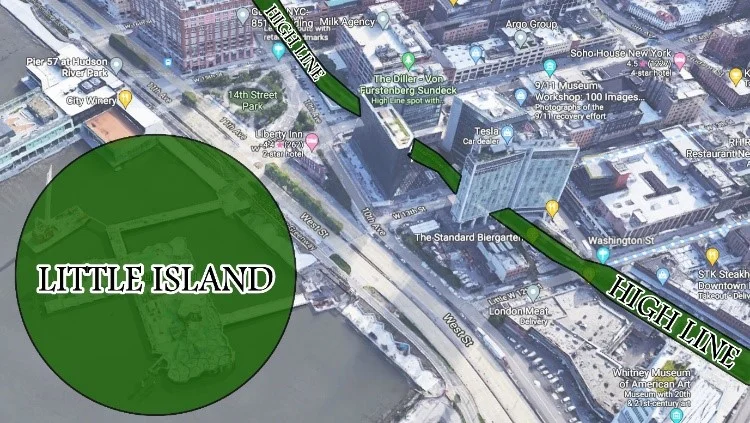
Given its proximity to the High Line, “Little Island” is likely to become another key landmark of New York City. Heatherwick emphasizes that this space was designed as a retreat from the urban environment, allowing users to observe the city from outside.
The preservation of the remains of Pier 54 has created a connection between the historical authenticity and the new social identity of “Little Island.” The entire project can be viewed as a panoramic viewpoint. It has been carefully integrated into the water to offer a variety of perspectives.
Throughout the park, users encounter unique viewpoints and never experience repetitive sightlines. The mystery of the pathways, along with whimsical elements like spiral slides, adds to the uniqueness of each section. The high level of design detail and execution is another strength of this project.
The upcoming winter may highlight a significant drawback of “Little Island,” as the lack of enclosed spaces could become an issue. Based on the project’s documentation (plans, sections, photos, and videos), it seems that the project does not adequately account for thermal comfort (hot summer sun) or weather conditions (rain and snow).
The vegetation for this project was selected with great care, considering the region and seasonal changes. The planting plan for different seasons supports this claim. The dynamic planting scheme, involving the deliberate choice of 400 different plant species, will provide the park with a colorful appearance throughout the year.
What is the most important lesson to be learned from the “Little Island” project? If there is one key takeaway, it is the importance of private sector investment in urban projects. The notable point is that nearly all of “Little Island’s” construction costs were covered by a private foundation. The Diller_von Furstenberg Foundation invested approximately $260 million in the design and construction of this project. Despite reasonable criticisms of private investment in such projects, one of the biggest advantages remains the potential to produce high-quality urban projects.
A review of private investment in urban projects: Investors aim for a quick return on their capital, along with reasonable profit. However, to achieve this, the project must gain approval from a significant portion of society and experts in fields such as landscape, urban planning, urban management, urban design, and architecture.
For the project to succeed in this regard, it must meet various criteria and maintain high quality in each. Thus, it can be concluded that private sector involvement in investment (and, on the other hand, design and execution) of landscape projects can lead to an improvement in project quality, the definition of new projects, analysis, research, critique, and the reform of existing projects, free from the bureaucracy typical of higher-level organizations, budget allocations, and so on.
This successful model could be further developed and rationalized through additional research, making it a structured approach to present to higher-level organizations and relevant authorities in Iran. It is hoped that professors, researchers, students, and landscape architecture professionals in Iran will refine this idea and, by implementing these methods and identifying their strengths and weaknesses, help improve the quality of landscape architecture in our country.
Sources:
Little Island Park / Heatherwick Studio
Thomas Heatherwick’s Little Island park and outdoor theatre opens on the Hudson